Cart
0
Most adults who ask "should I learn guitar or ukulele?" already have a gut answer. They just want permission to go with the easier one — or reassurance that picking the harder one won't end in a dusty instrument under the bed six months from now.
Here's the honest version of this comparison: neither instrument is universally better for beginners. But one of them will almost certainly be better for you, based on factors most comparison posts skip entirely. Let's get into it.
The Physical Reality Nobody Warns You About
Both instruments require your fingertips to press steel or nylon strings against a fretboard — and both will make your fingertips sore for the first few weeks. That's unavoidable. But the degree of physical demand is genuinely different.
Ukulele: Four nylon strings at lower tension means less finger pressure required to fret a clean note. The body is smaller, the neck is narrower, and the scale length is shorter — all of which makes it more manageable if you have smaller hands or haven't built up any grip strength. Chord shapes that would take a guitarist weeks to nail can feel accessible within your first few sessions on a ukulele.
Guitar: Six strings, a longer neck, and (on steel-string acoustics) higher string tension add up to a steeper physical entry point. Barre chords — where you press one finger flat across all six strings — are a notorious wall for beginners, and most popular songs eventually require at least a few. That said, open chords on guitar are entirely playable early on, and many songs never need a barre chord at all.
If you have any wrist, hand, or joint sensitivity, the ukulele's lower tension is a meaningful advantage, not just a comfort perk.
Time to Your First Song
This is where the ukulele wins clearly, and it's worth being specific about why.
On a ukulele, the four most common chord shapes — C, Am, F, G — are simpler to finger than their guitar equivalents, and strumming a basic rhythm pattern feels natural faster because the instrument is lighter and easier to hold steady. A motivated adult beginner can often play a recognizable song within the first week of consistent practice.
On guitar, the same four chords exist but require more finger independence and pressure to produce a clean sound. Two to four weeks of consistent practice before you're playing something that sounds like a real song is a more realistic expectation for most adults starting from zero.
Two weeks might not sound like much, but for adult learners juggling jobs, kids, and irregular practice windows, that gap in early momentum matters. Early wins keep you practicing. Frustration stops you.
Which One Punishes Inconsistent Practice Less
This is the question almost nobody asks, and it might be the most important one for adults.
Kids learning instruments often have structured lesson schedules and parents keeping them accountable. Adults don't. Life intervenes. You'll miss a week. Sometimes two. The question is: how much do you lose when you come back?
Ukulele: Because the physical demands are lower and the chord shapes are simpler, returning after a break feels less punishing. Your fingers lose less callus, and the muscle memory for basic chords comes back faster. It's a more forgiving instrument for the stop-start reality of adult learning.
Guitar: The calluses on your fingertips take longer to build and fade faster when you stop. Barre chords that were starting to click can feel like starting over after a two-week break. Guitar rewards consistent, frequent practice more than ukulele does — which is great if your schedule allows it, and genuinely discouraging if it doesn't.
Be honest with yourself here. If you can realistically commit to practicing several times a week, guitar's higher ceiling is worth the steeper climb. If your schedule is unpredictable, the ukulele will keep you engaged longer.
Cost of a Decent Beginner Setup
Both instruments are accessible at the entry level, but the total cost of a beginner-ready setup differs.
A decent beginner ukulele — one that stays in tune, doesn't fight you with high action, and sounds pleasant — costs less than a comparable beginner acoustic guitar. You also don't need an amplifier, and accessories like a tuner, strap, and spare strings add up to less overall. It's the more budget-friendly starting point if cost is a real constraint right now.
A beginner acoustic guitar setup costs more, partly because the instrument itself is larger and more materials-intensive to build, and partly because a gig bag, tuner, picks, and a capo (useful for beginners) add up. Electric guitar adds an amplifier to the list, which shifts the budget significantly.
Neither instrument requires you to spend a lot to get something genuinely playable. But if you're testing whether you'll stick with music before committing a larger budget, the ukulele lets you do that with less financial risk.
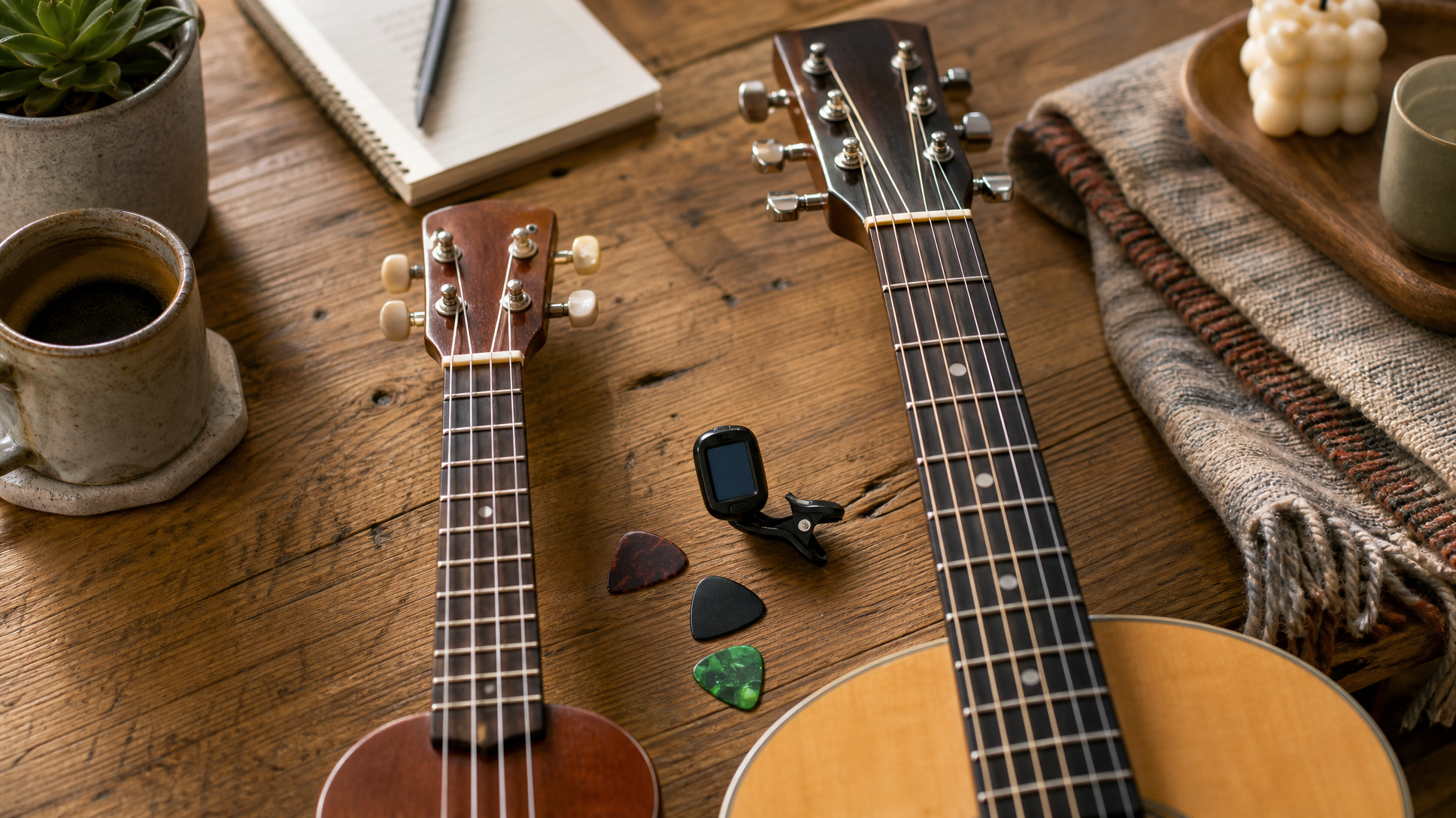
The Music You Actually Want to Play
Price and difficulty are valid factors — but they shouldn't override this one.
If the songs you want to play are on guitar, learning ukulele is a detour. You'll eventually have to start over on a different instrument, or you'll stay on ukulele and feel like you're playing the wrong thing. Neither outcome is great.
Ukulele has a genuinely distinct sound and repertoire. It's not a smaller, easier guitar — it's its own instrument. If you love that bright, warm, slightly tropical tone and want to play music that fits it, that's a real and valid reason to choose it. But if your mental image of yourself playing music involves a guitar, trust that instinct.
A good test: search YouTube for "ukulele cover" of a song you love. If it sounds right to you, ukulele is a genuine fit. If it sounds like a novelty version of the real thing, that's useful information.
An Honest Side-by-Side
| Ukulele | Guitar | |
|---|---|---|
| Physical demand | Lower — nylon strings, less tension | Higher — more finger pressure required |
| Time to first song | Faster — often within the first week | Slower — typically 2–4 weeks for most adults |
| Forgives inconsistent practice | Yes — easier to pick back up after a break | Less so — rewards regular, frequent sessions |
| Entry-level cost | Lower overall setup cost | Moderate — more for electric + amp |
| Long-term ceiling | Deep, but narrower genre range | Very high — spans nearly every genre |
| Best for | Irregular schedules, tighter budgets, smaller hands | Clear musical goals, consistent practice time |
The One Thing Worth Saying Plainly
The best first instrument is the one you'll actually pick up tomorrow. If a ukulele sitting on your couch gets played every other day, it beats a guitar gathering dust in the corner every time. Don't romanticize the harder choice just because it sounds more serious — adult learners quit instruments because of friction, not lack of talent.
That said, if guitar is genuinely what you want, don't talk yourself out of it with ukulele as a compromise. Go straight to what you're after. The early difficulty is real but temporary, and the payoff is exactly what you imagined.
Before you decide, it's also worth reading up on what to check before ordering instruments online — things like action height, setup quality, and return policies matter a lot when you're buying a first instrument sight unseen.
Ready to compare your options? Browse beginner guitars and ukuleles at Emusicmart — filter by price, brand, and what fits your budget, and you'll find both instruments across a range of entry-level setups in one place.
Frequently Asked Questions
Is ukulele easier to learn than guitar for adults with no music background?
Generally, yes — the ukulele has fewer strings, lower string tension, and simpler beginner chord shapes, which means most adults reach their first playable song faster. That said, "easier" depends on your goals: if you want to play guitar music, learning ukulele first doesn't really shortcut the process.
Can I transfer what I learn on ukulele to guitar later?
Some things carry over — basic strumming rhythm, reading chord diagrams, and ear training all transfer. But the chord shapes, string count, and tuning are different enough that switching instruments still requires learning from scratch in meaningful ways. If guitar is your end goal, starting on guitar is usually the more direct path.
What size ukulele should a beginner adult get?
A concert or tenor ukulele is usually a better fit for adult hands than a soprano — the slightly longer neck and larger body give your fingers more room between frets. Soprano ukuleles are the most traditional size but can feel cramped for adults with larger hands.
Do I need to take lessons, or can I learn guitar or ukulele on my own as an adult?
Many adults learn both instruments successfully through free online video tutorials and structured apps without formal lessons. Lessons can accelerate progress and catch bad habits early, but they're not required — especially at the beginner stage. The most important factor is consistent, intentional practice, however you structure it.