Cart
0
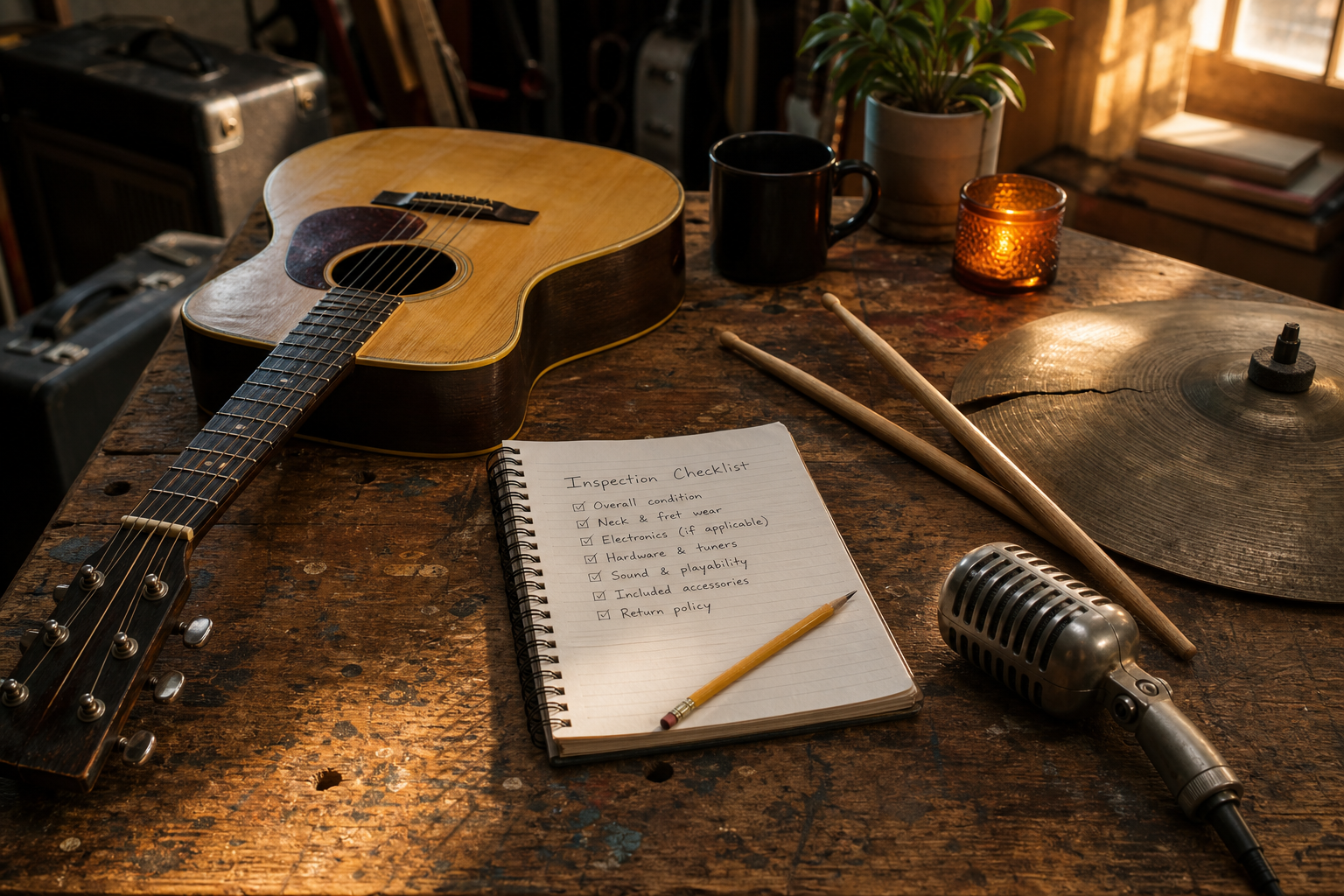
A used guitar listed at half the retail price looks like a no-brainer. Then it arrives and the neck has a back-bow, the tuners slip, and the seller's account is already gone. It happens more than people admit, and it happens across every instrument category — not just guitars.
If you're shopping secondhand online, you're working with limited information and zero hands-on access. That's not a reason to avoid used gear entirely — it's a reason to know exactly what to look for before you commit. Here are five things that separate a smart used buy from an expensive mistake.
1. Demand More Photos Than the Seller Offers
Most used listings show the instrument from its best angle in decent lighting. That's marketing, not disclosure. Before you buy anything, ask for photos of the specific spots that hide damage: the back of the headstock (where guitars get dropped), the edges of drum shells (where cracks start), the underside of a keyboard (where liquid damage pools), and any area the original photos deliberately avoid.
If a seller is slow to send additional photos, or sends blurry ones, treat that as your answer. A seller with nothing to hide will send you ten clear photos within a day. One who drags their feet is either hiding something or doesn't actually have the instrument in hand — both are problems.
For electronics like audio interfaces, mixers, or amplifiers, ask for a short video of every knob, fader, and input being used. Crackling pots, dead channels, and intermittent outputs are impossible to spot in a photo but obvious the second you hear them.
2. Know Which Instrument Categories Carry the Most Risk
Not all used gear is equally risky. Some instruments age gracefully; others hide expensive problems under a clean exterior.
High risk: Acoustic guitars and basses. Wood moves with humidity and temperature, and years of neglect can leave a neck warped, a top bellied behind the bridge, or a seam separating at the body. These repairs can cost more than the instrument is worth. Check the action at the 12th fret in photos — if the strings look unusually high, the neck or top has likely shifted.
High risk: Vintage or older electronics. Amplifiers, mixers, and outboard gear from an unknown storage history can have failing capacitors, oxidized contacts, or wiring that's been modified badly. Unless you know how to service electronics yourself, budget for a tech inspection before you trust it in a performance or recording context.
Moderate risk: Drum kits. Shells themselves are fairly durable, but hardware wears, heads need replacing, and cymbals crack — cracks that are easy to miss in a photo taken from above. Ask specifically about cracks along the bow of each cymbal, not just the edge.
Lower risk: Solid-body electric guitars and basses (if not heavily modified), standard microphones from reputable brands, and most passive accessories. These tend to hold up well and their condition is easier to verify visually.
3. Ask the Seller the Questions They're Not Expecting
Generic questions get generic answers. Specific questions reveal whether a seller actually knows what they're selling — or is just flipping something they picked up at an estate sale.
Try these:
- "Has this instrument ever been repaired or had any part replaced?" — A refretted guitar isn't a dealbreaker, but you deserve to know. An undisclosed neck reset on an acoustic changes the value conversation entirely.
- "How long did it sit in storage, and where?" — A garage in Houston summers is a different story than a climate-controlled music room.
- "Why are you selling it?" — Not because the answer is always honest, but because a seller who can't give you a coherent reason is worth being skeptical of.
- "Does it come with the original case, paperwork, or accessories?" — Missing cases mean higher shipping risk. Missing documentation on a vintage piece can affect its value significantly.
The goal isn't to catch the seller in a lie. It's to gather enough information to make a real decision — and to see how they handle direct questions.
4. Understand What "Return Policy" Actually Means in a Private Sale
On most private marketplaces, "all sales final" is the default, not the exception. Once the money moves and the instrument ships, your recourse is limited to whatever the platform's dispute process offers — which is often slow, inconsistent, and weighted toward whoever has better documentation.
Before you pay, get clear answers to: Does the seller accept returns if the instrument isn't as described? Who pays return shipping? What counts as "not as described"?
If the seller won't commit to any return window for a significantly misrepresented item, price that risk into your offer. A guitar listed at $400 with no recourse is not the same deal as a $400 guitar from a retailer with a clear return policy. The difference in peace of mind is real, and it's worth factoring in.
This is one area where buying new from a reputable retailer has a concrete, practical advantage — not just a psychological one. If you're comparing options, it's worth reading through what to check before ordering instruments online to see how a structured retailer handles the things a private seller usually won't.
5. Do the Real Math Before You Commit
Used gear pricing often looks better than it is once you account for everything the listing doesn't mention. Run the actual numbers before you decide.
Add up: the asking price, shipping (which is not cheap for a guitar case or a drum kit), any setup or repair work you can already anticipate, replacement parts that are clearly worn (heads, strings, tubes, a missing strap button), and the cost of your time if something goes wrong. Then compare that total to the price of a new equivalent from a retailer with free or flat-rate shipping and a return policy.
Sometimes used still wins — especially for discontinued gear, vintage instruments with genuine character, or categories where new entry-level options are noticeably lower quality than used mid-range ones. But sometimes the math doesn't hold up, and you're better off buying new and knowing exactly what you're getting.
The point isn't to avoid used gear. It's to stop treating the sticker price as the whole story.
If you've done the checklist and decided new makes more sense for what you need, browse Emusicmart's catalog — straightforward pricing, secure checkout, and clear return policies with no seller guesswork. Over 25,000 products across guitars, drums, keyboards, pro audio, recording gear, and accessories, all shipped within the U.S.
Frequently Asked Questions
Is it ever a good idea to buy a used instrument online without playing it first?
Yes, but it requires more due diligence than buying in person. Stick to sellers who provide detailed photos, answer specific questions clearly, and offer some form of return window if the instrument is significantly misrepresented. The more documentation you can gather before paying, the lower your risk.
For lower-risk categories like solid-body electrics or standard microphones, the process is more forgiving. For acoustic instruments or older electronics with unknown histories, be more cautious — or factor potential repair costs into what you're willing to pay.
What are the biggest red flags in a used instrument listing?
Blurry or limited photos, a seller who is slow or evasive when asked for more images, a price that seems unusually low with no explanation, and listings that say "selling as-is" or "no returns" without disclosing any known issues. Also watch for sellers who can't answer basic questions about the instrument's history — if they don't know how it was stored or whether it's been repaired, you can't make an informed decision.
How do I know if a used guitar neck is warped from photos alone?
Ask the seller to photograph the neck from the headstock end, looking down the length of the fretboard toward the body — this is called "sighting the neck" and it reveals bow or twist that a straight-on shot hides. Also ask for a photo of the action at the 12th fret with a ruler or coin for scale. Strings sitting unusually high off the fretboard can signal a neck or body problem that's expensive to correct.
When does buying new make more financial sense than buying used?
When the total cost of the used instrument — including shipping, likely repairs, and replacement parts — comes close to or exceeds the price of a new equivalent. It also makes sense when you need a return policy you can rely on, when the instrument category carries high structural risk (like acoustics stored in poor conditions), or when the used listing lacks enough information to make a confident decision. New isn't always the better value, but it's often the lower-risk one.