Cart
0
Most people shopping for a microphone spend their time comparing brands and prices when the more important question is simpler: what shape of mic do you actually need? Buy the wrong type and it doesn't matter how good the specs are — you'll still end up with muffled audio, a tangled cable at the worst moment, or a mic that simply won't connect to your phone.
The four microphone categories covered here — wired handheld dynamic, wired lavalier, plug-in wireless lavalier, and dual wireless lavalier with noise reduction — cover the vast majority of real-world recording situations. Here's how to figure out which one belongs in your kit.
1. Wired Handheld Dynamic — The Reliable Workhorse
If you're doing karaoke nights, public address work, or live vocal performances where you want to hold the mic and own the room, a wired dynamic is still the most practical choice. There's no battery to die mid-set, no pairing to troubleshoot, and no signal dropout.
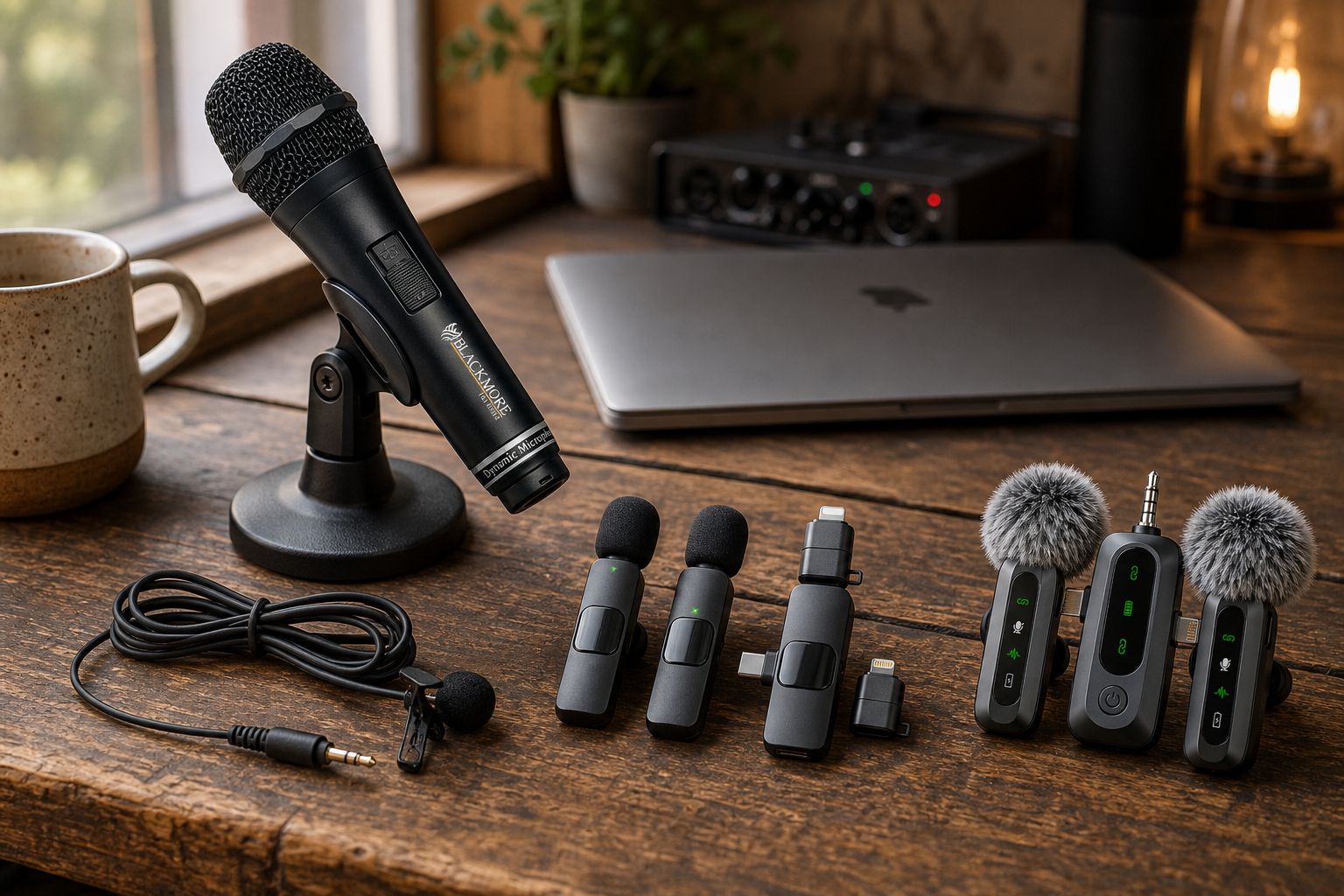
The Blackmore Pro Audio Dynamic Microphone BMP-4 is a classic example of this form factor. It's a unidirectional dynamic mic with a frequency range of 50 Hz to 16,000 Hz, a nominal impedance of 600 ohms, an on/off switch on the body, and a detachable 10 ft. cable with XLR or 1/4 in. connectivity. That XLR/1/4 in. flexibility matters: it means you can run it into a PA mixer or a basic amp without hunting for adapters.
The trade-off is obvious — you're tethered. For video recording, a handheld mic in frame often looks awkward unless it's an intentional interview or podcast aesthetic. For live performance and karaoke, though, it's exactly right.
Best for: Karaoke, live vocals, PA systems, podcasts recorded at a desk.
2. Wired Lavalier — Hands-Free, No Fuss
Clip a lavalier to your collar and forget it's there. That's the appeal. Wired lavs have been the go-to for presenters, teachers recording lessons, and interviewers for decades — and they still make sense when your recording environment is controlled and you don't need to move far from your device.
The Saramonic SR-M1 3.5mm Lavalier Microphone has a 4.1 ft. (1.25 m) cable and connects via a standard 3.5mm plug. It's designed to work with portable recorders, DSLR and mirrorless cameras, and wireless transmitters — and it's built as a replacement lavalier for Saramonic Blink 500 and Blink 500 Pro wireless systems, which means it's engineered to a higher standard than a generic clip-on.
The limitation is the cable length. About 4 feet keeps you close to your camera or recorder. That's fine for a seated interview or a tutorial at a workbench. It's not fine if you're walking around a venue or filming outdoors with any distance between you and your phone.
Best for: Seated interviews, tutorial videos, camera operators who want a clean lav feed without wireless complexity.
3. Plug-In Wireless Lavalier — The Phone Videographer's Best Friend
This is the category that's changed mobile video the most in the past few years. A plug-in wireless lav connects a small receiver directly into your phone's charging port — no Bluetooth pairing, no separate recorder — and the transmitter clips to your shirt. You get wireless freedom with almost no setup.
The 2 Pack Wireless Lavalier Microphone with Charging Case from AMASDA is built for exactly this use case — iPhone, iOS, and Android compatibility, with a charging case included so the transmitters are ready when you are. The two-pack means you can mic two people simultaneously, which is ideal for interviews, co-hosted podcasts filmed on a phone, or any situation where two voices need to be captured cleanly.
What you give up compared to a wired lav is a small amount of audio fidelity in some conditions, and you're dependent on battery life. But for TikTok, YouTube vlogs, and short-form video where the phone IS the camera, this form factor is genuinely hard to beat for convenience.
Best for: Solo creators, vloggers, TikTok/YouTube content, on-the-go interviews, any recording where the phone is the camera.
4. Dual Wireless Lavalier with Noise Reduction and LED Display — When You Need More Control
Step up from the basic plug-in wireless and you get systems that add noise reduction processing, signal status indicators, and broader device compatibility in a single receiver. This is the right move when you're recording in noisier environments — a busy café, an outdoor event, a classroom — or when you need to confirm at a glance that both mics are connected and transmitting.
The CDMVAB 3-in-1 Wireless Lavalier Microphone 2 Pack addresses that with a 3-in-1 receiver that connects to iPhone, iPad, Android devices, and cameras from a single unit — no swapping adapters depending on which device you're shooting on. The LED display gives you real-time status feedback, and noise reduction is built into the system. Two transmitters are included, so it handles two-person recordings out of the box.
This is the most versatile setup in this roundup if your recording situations vary — sometimes a phone, sometimes a camera, sometimes indoors, sometimes not.
Best for: Podcasters, interviewers, educators, content creators who record across multiple device types or in variable environments.
So Which One Do You Actually Need?
Here's the honest shortcut: start with your recording device and your mobility, not the microphone.
- Phone is your camera, you move around: Plug-in wireless lav (AMASDA 2-pack or CDMVAB 3-in-1).
- Camera or recorder, controlled environment: Wired lavalier (Saramonic SR-M1).
- Live performance, PA, or karaoke: Wired handheld dynamic (Blackmore BMP-4).
- Multiple devices, noisy locations, need signal feedback: CDMVAB 3-in-1 with LED display.
The mic type gets you 80% of the way there. Brand and price close the rest of the gap. Get the form factor wrong and no amount of spec-chasing fixes it.
Browse microphones and audio gear at Emusicmart — secure checkout, U.S. shipping. And if you're still working out what to look for before you buy gear online, the guide on ordering instruments online walks through exactly what to check before you commit.
Frequently Asked Questions
Can I use a lavalier microphone with any phone?
It depends on the connection type. A wired 3.5mm lavalier works with phones that have a headphone jack, but most modern iPhones and many Android phones don't. Plug-in wireless lavs like the AMASDA 2-pack or CDMVAB 3-in-1 are designed specifically for this — they connect via the phone's charging port (Lightning or USB-C) and typically include adapters for broader compatibility, so no headphone jack is needed.
What's the difference between a dynamic microphone and a lavalier microphone?
A dynamic microphone (like the Blackmore BMP-4) is a handheld mic designed to capture sound from directly in front of it — good for vocals, live performance, and situations where you hold or stand close to the mic. A lavalier is a small clip-on mic worn on the body, designed to capture speech hands-free from a fixed position on your clothing. They serve different use cases rather than one being better than the other.
Do wireless lavalier microphones have audio quality issues compared to wired ones?
For most video recording purposes — vlogs, interviews, podcasts, social content — a good plug-in wireless lavalier delivers audio that's more than sufficient. The convenience gain usually outweighs any marginal quality difference. Where wired lavs still have an edge is in highly controlled studio environments where every detail of the signal chain matters. For phone video, the wireless format wins on practicality.
What does noise reduction in a wireless mic system actually do?
Noise reduction in a wireless lavalier system (like the CDMVAB 3-in-1) processes the incoming audio signal to reduce background noise — things like HVAC hum, crowd murmur, or ambient room noise — before it reaches your recording device. It's particularly useful when you're recording in environments you don't fully control. It doesn't replace a quiet room, but it meaningfully cleans up audio in real-world, imperfect conditions.