Cart
0
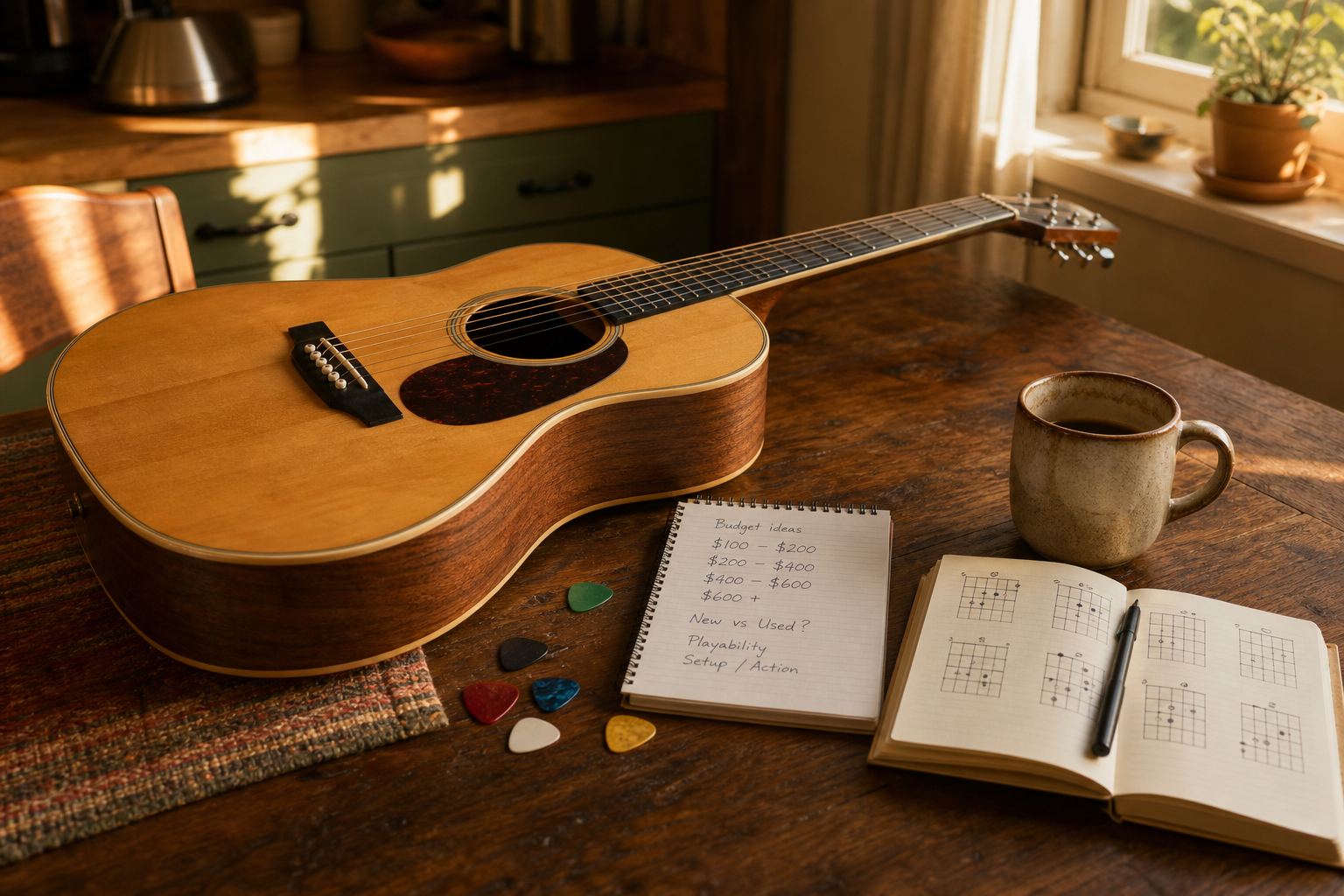
The advice is everywhere: spend around $200 on your first guitar. It gets repeated on forums, in YouTube comments, and by well-meaning friends who learned a decade ago. The problem isn't that the number is wrong — it's that nobody ever explains why, or what happens to your playing experience if you spend half that, or what you'd actually gain by spending more.
So let's fix that. This guide breaks down what changes at each price tier — materials, playability, sound, hardware — so you can pick a number that makes sense for your situation, not just one you found on Reddit.
What Actually Determines an Acoustic Guitar's Price?
Before the tiers, it helps to know what manufacturers are trading off when they price a guitar. There are four main levers:
- Tonewoods — the wood used for the top, back, and sides. Solid wood resonates differently (and usually better) than laminate. It also costs more to source and work with.
- Build quality — how well the neck is set, how the frets are finished, whether the nut and saddle are cut properly. Poor builds create buzzing, tuning problems, and high action that makes fretting painful.
- Hardware — tuning machines (tuners) that hold pitch reliably vs. ones that drift constantly.
- Setup — whether the guitar leaves the factory (or a shop) with the action and intonation adjusted correctly. Many budget guitars skip this step entirely.
Keep those four in mind as we move through the tiers.
Under $100: Proceed With Caution
There are playable guitars in this range, but the odds are stacked against you. At this price point, manufacturers are cutting costs on everything simultaneously — laminate tops, laminate backs and sides, budget tuners, and almost certainly no professional setup.
The result is often a guitar with high action (the strings sit too far from the fretboard), which means pressing down a chord takes noticeably more force than it should. For a beginner whose fingertips aren't yet calloused, that's discouraging in a way that can kill motivation before it has a chance to build.
That said, this tier isn't worthless. If a child wants to try guitar before anyone's sure they'll stick with it, a sub-$100 instrument is a reasonable experiment. Just know what you're getting.
$100–$200: The Real Entry Point
This is where beginner guitars stop being a gamble and start being a genuine instrument. You'll typically find all-laminate construction — which is fine — but from manufacturers who have enough margin to do a decent factory setup and use hardware that holds tune through a full practice session.
Playability is meaningfully better here. The action is usually set to a reasonable height, fret ends are less likely to be sharp, and the guitar will stay in tune long enough for you to actually learn what in-tune sounds like. That last part matters more than people realize.
If your budget is firm and this is your ceiling, buy confidently in this range — just do a little research on which specific models have a reputation for good quality control out of the box.
$200–$400: Where Most Beginners Should Land
This is the tier the standard advice is pointing at, and for good reason. A few things shift meaningfully here:
Solid tops start appearing. A solid spruce or cedar top vibrates as a single piece of wood rather than layers, which gives the guitar more resonance and a sound that opens up and improves as it's played over time. Laminate backs and sides are still common at this price — and that's fine, they're durable — but a solid top makes a real audible difference.
Build consistency improves. Brands competing seriously in this space (there are several well-regarded ones) put more attention into fret leveling, nut slots, and neck geometry. You're less likely to buy a lemon.
Tuners hold pitch reliably. Small thing, huge quality-of-life improvement when you're learning.
If you're a motivated adult who's committed to learning — or a teenager who's been asking for months — this is the range to target. The guitar won't hold you back as you improve, and you won't feel the urge to immediately upgrade in six months.
$400–$700: Serious Starter Territory
At this point you're often looking at all-solid construction — solid top, solid back, solid sides. The guitar sounds noticeably richer and more complex, and it will continue to improve with age and play in a way laminate simply doesn't.
The setup and finish quality also step up. Fret ends are smooth, the nut and saddle are usually cut by someone who knows what they're doing, and the guitar feels like a finished instrument rather than a production-line approximation of one.
Is this where a first-time buyer should start? Honestly, only if you're an adult who's tried guitar before and knows you'll stick with it, or you're buying for someone who's already been playing on a borrowed or entry-level instrument and is ready for something real. Spending here on a complete beginner isn't a waste, but it's more than the instrument needs to be to do the job.
The Setup Question Nobody Mentions
Here's something that gets skipped in most buying guides: regardless of what you spend, a professional setup from a local guitar tech — typically a modest one-time cost — can transform a decent guitar into a great-playing one. A tech will adjust the action, check the intonation, and dress any sharp fret ends.
If you're buying in the $150–$250 range and the guitar feels stiff or buzzy out of the box, don't assume the guitar is bad. Get it set up first. It's one of the most cost-effective improvements you can make to any instrument.
One More Thing: Body Size
Price isn't the only variable. Body size affects playability too, especially for younger players or adults with smaller frames. A full-size dreadnought is the most common shape, but a parlor or concert body is easier to hold and often more comfortable for sitting practice. If you're buying for a child, check the recommended age ranges for sizing — a guitar that's physically awkward to hold is just as discouraging as one with high action.
So, What Should You Spend?
Here's the honest answer:
- Trying it out / buying for a young child: Under $150 is fine. Keep expectations realistic.
- Committed beginner, adult or teen: $200–$350 is the sweet spot. Solid top if you can find it in budget.
- Returning player or serious starter: $350–$600. All-solid construction, better hardware, and a guitar that grows with you.
Don't let the internet's generic advice make this feel more complicated than it is. Pick the tier that matches your commitment level, spend toward the middle of it rather than the bottom, and if the guitar feels stiff when it arrives, get it set up before you decide it's not for you.
Before you buy anywhere online, it's also worth knowing what to look for in a retailer — things like return policies, shipping reliability, and product accuracy. Our guide on ordering instruments online: what to check before you buy walks through exactly that.
Ready to find your first guitar? Browse acoustic guitars at Emusicmart and filter by price range to see what's available at your budget — no guesswork required.
Frequently Asked Questions
Is it worth buying a guitar bundle (guitar + accessories) as a beginner?
Bundles can be a good deal if they include genuinely useful accessories — a tuner, a capo, picks, and a gig bag are all things you'll actually need. The tradeoff is that the guitar itself in a bundle is usually at the lower end of that price tier, so you're trading a slightly better instrument for convenience. If the bundle's guitar model has good reviews on its own, it's a solid buy. If the guitar is unknown and the bundle is just padded with cheap accessories, it's worth buying the guitar separately.
What's the difference between a solid top and a laminate top, and does it really matter for a beginner?
A solid top is a single piece of wood that vibrates as a whole, producing more resonance and a richer sound that improves as the guitar ages and is played. A laminate top is layers of wood pressed together — more resistant to humidity changes and dings, but acoustically flatter. For a complete beginner, the difference is real but not dramatic. Where it matters more is over time: a solid-top guitar rewards consistent playing in a way laminate doesn't, so if you plan to stick with it, a solid top is worth prioritizing.
Should I buy a guitar online or in a store as a beginner?
Playing before you buy is ideal if you have access to a decent local shop, but most beginners can't reliably evaluate a guitar in a store anyway — you don't yet know what "good" feels like. Buying online from a retailer with a clear return policy is a perfectly reasonable approach, especially when you're targeting a well-reviewed model in a known price tier. Just make sure the return window is long enough for you to actually play it for a few days before deciding.
How do I know if a guitar's action is too high without a tech telling me?
Press down a string at the first fret and look at how much space there is between the string and the fret. If it looks like a significant gap — or if forming a simple open chord like G or C requires noticeably more effort than you'd expect — the action is probably too high. Another sign: the guitar sounds slightly sharp when you fret notes compared to how they sound open. A local guitar tech can measure and adjust this in a single appointment, and it makes an immediate difference in how easy the guitar is to play.