Cart
0
The List Looks Simple. It Isn't.
The supply list comes home in a folder, usually the first week of school. It says something like: Concert flute, standard student model. Maybe it adds a music stand and a method book. You order everything on the list, pat yourself on the back, and then your kid shows up to the first rehearsal and the director asks where the cleaning swabs are.
This happens to almost every band parent the first year. The official list is a starting point — it's not a survival guide. Here's what it's missing.
The Accessories That Are Actually Required (Just Not Written Down)
Directors assume certain things come with the territory. They're not always wrong to assume — but they're also not always right to assume you know. Before the second week of school, most students will need:
For woodwinds (clarinet, saxophone, oboe, bassoon)
- Reeds — and not just one. Reeds break, squeak, and warp. A beginner should have at least three on hand at all times. Ask the director which brand and strength they prefer before buying a box of the wrong ones. Many directors are specific about this.
- Reed case or holder — loose reeds in a backpack pocket don't survive the week.
- Cork grease — essential for assembling a clarinet or saxophone without forcing joints and cracking the tenon cork.
- Swabs and cleaning cloths — interior swabs for pulling moisture after every play session, and a soft cloth for the exterior. Skipping this leads to sticky pads and expensive repair bills.
- Neck strap (saxophone, bass clarinet, English horn) — usually not included in the case.
For brass (trumpet, trombone, French horn, tuba)
- Valve oil or slide cream — a trumpet without valve oil is unplayable within a week. Buy two bottles. They disappear.
- Mouthpiece brush and cleaning snake — brass instruments need regular flushing. The snake gets into the tubing; the brush handles the mouthpiece.
- Trombone slide cream and water spray bottle — these are separate from valve oil and both are necessary.
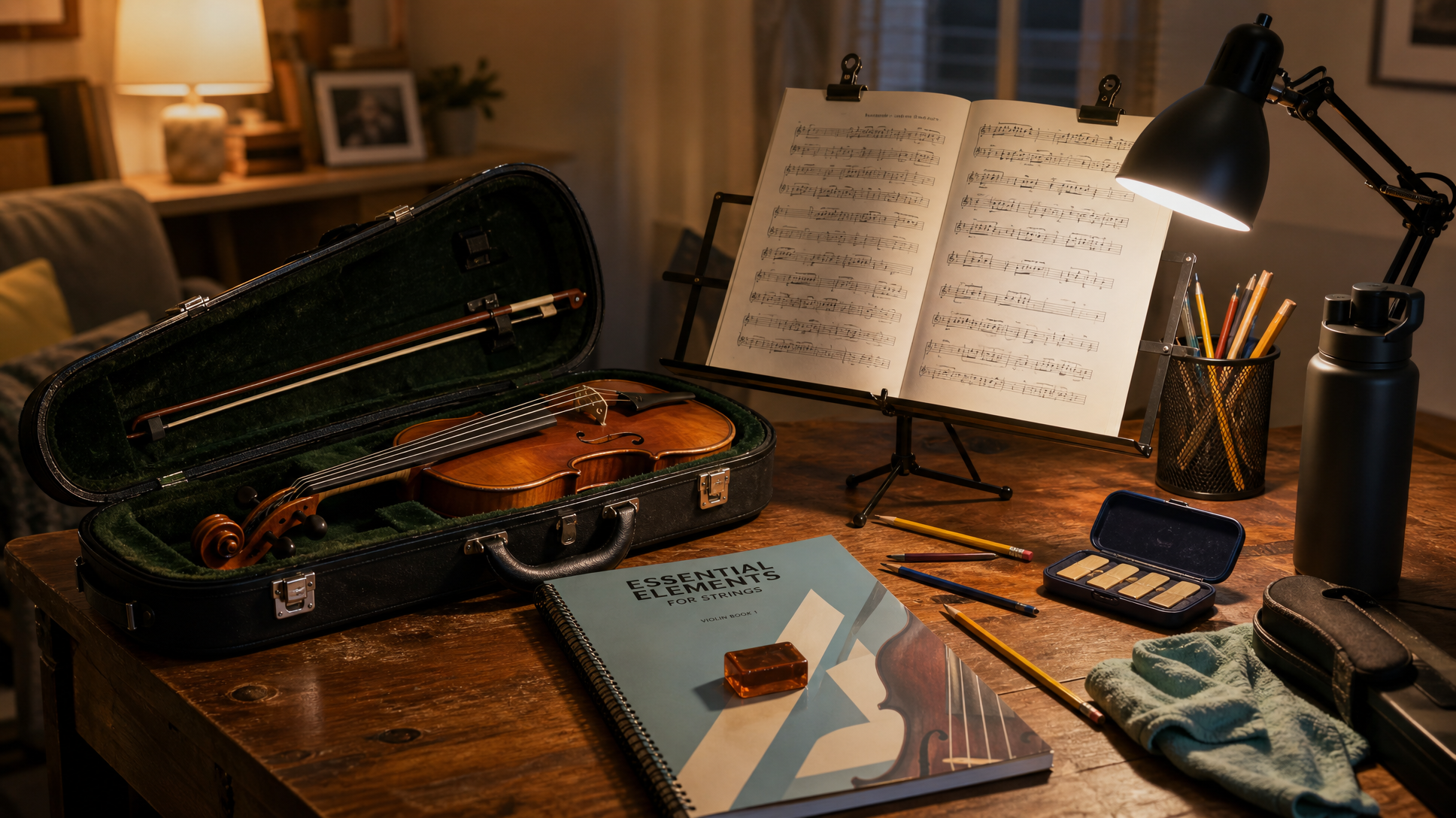
For strings (violin, viola, cello, bass)
- Rosin — no rosin, no sound. It's often not included with rental instruments, even when the case looks fully stocked.
- Extra strings — at minimum, an extra E string for violin (the most likely to snap mid-practice). Ask the director which brand they recommend; some are particular.
- Shoulder rest (violin and viola) — many beginners need one, but it's rarely on the list. Whether your child uses one depends on their teacher's preference, so ask first.
- Cleaning cloth — rosin dust builds up on the body of the instrument and, over time, damages the finish.
For percussion
- Stick bag — drumsticks get lost, borrowed, and broken. A stick bag keeps them organized and the student accountable for their own gear.
- Practice pad — most directors expect beginners to do a significant amount of work at home before touching a school drum. A practice pad is non-negotiable.
- Mallets — if your student will be on bells or xylophone, they need their own mallets. Ask which type.
The Rental vs. Buy Decision (And Why Cheap Rentals Sometimes Aren't)
Renting makes sense for beginners — especially for larger instruments like cello, tuba, or bass clarinet that the student may not stick with. But the cheapest rental option deserves some scrutiny before you sign.
A few things worth asking before committing to any rental program:
- Is maintenance included? Some programs cover repairs; others charge separately for every pad replacement and dent removal. A $20/month rental that charges $80 for a stuck key in February isn't actually cheap.
- Does rent apply toward purchase? Rent-to-own programs can make sense if your student stays with the instrument. Read the fine print on how much credit actually accumulates.
- What condition are the rental instruments in? School rental fleets vary widely. If you pick up an instrument and the keys stick, the slides are sluggish, or the bow is warped, it's worth asking for a different one. A struggling beginner on a poorly maintained instrument is fighting two problems at once.
For some instruments — especially beginner-level flutes, clarinets, and student violins — buying outright at a reasonable price can cost less over a full school year than renting, and you own something at the end of it. It depends on your student's commitment level and the instrument.
Questions to Ask the Director Before You Buy Anything
Seriously — a five-minute conversation (or a quick email) before you spend money can save real frustration. Directors have preferences, and those preferences matter more than whatever the supply list says.
- Do you have a preferred brand or model for this instrument? Many directors steer beginners toward specific student-line instruments they know hold up and stay in tune.
- What reed brand and strength do you recommend? (Woodwinds only — but this one matters a lot.)
- What method book will we use? Some are already included in fees; buying a duplicate is a waste.
- Do you expect students to have a music stand at home? Many do. A decent folding stand is inexpensive and makes home practice dramatically easier.
- Is there anything I should avoid buying? Directors are often happy to tell you which off-brand instruments cause problems in class. Ask.
What You Can Safely Skip (At First)
Not everything marketed to band parents is necessary in year one. You don't need a professional-grade metronome if your student's phone already has a tuner app. You don't need a humidity control system for a clarinet kept in a typical American home (though a cello or violin in an extremely dry environment is a different story). And you definitely don't need to upgrade the mouthpiece on a beginner instrument in the first semester — that's a conversation for year two, if the student is still playing and progressing.
Buy the consumables, the maintenance basics, and the accessories the director specifically requests. Hold off on upgrades until there's a clear reason for them.
Where to Get It All Without Hunting Across Five Websites
One of the more tedious parts of this process is that band gear is scattered — the instrument from one place, reeds from another, a music stand from a third. Emusicmart.com carries instruments, accessories, and audio gear across all the major categories, so you can put together a full back-to-school kit in one order with U.S. shipping and secure checkout. If you're still figuring out what questions to ask before you buy, the guide on ordering instruments online and what to check first is worth a read before you add anything to your cart.
The supply list is just the starting point. Now you know what actually comes next.
Frequently Asked Questions
How many reeds should a beginner woodwind player keep on hand?
At minimum, three playable reeds at any given time. Reeds chip, warp, and sometimes just refuse to cooperate — having backups means a broken reed doesn't derail a practice session or a rehearsal. Buy a small box to start, and ask the director which brand and strength to get before you order.
Is it better to rent or buy a beginner instrument?
It depends on the instrument and your student's commitment level. Renting makes sense for expensive or large instruments (cello, tuba, bass clarinet) when you're not sure the student will stick with it. For smaller, more affordable instruments like student-level flutes or clarinets, buying outright can actually cost less over a full school year — and you own something at the end. Compare the total annual rental cost against a reasonable purchase price before deciding.
What's the one accessory most parents forget to buy?
For woodwinds, it's usually cork grease or a reed case. For brass players, it's valve oil (or trombone slide cream). For strings, it's rosin — which is so small and inexpensive that it seems like it must be included, but often isn't. Check the inside of the case carefully before assuming everything needed is already there.
Should I buy a music stand for home practice?
Yes, in most cases. Directors generally expect students to practice at home, and trying to prop sheet music on a dresser or hold it while playing is a real obstacle. A basic folding stand is inexpensive and makes a noticeable difference in practice quality. Ask the director whether they require one — many do.