Cart
0
The swab lives at the bottom of your case. You know it's there. You also know you didn't use it after last Tuesday's rehearsal, or the one before that. It's fine — until it isn't, and you're looking at sticky pads, a sluggish key action, or a repair bill that could have been avoided with two minutes of maintenance.
Cleaning a woodwind isn't complicated, but it does require the right tools used in the right order. This guide walks through the post-session routine for flute, clarinet, and baritone saxophone players — and explains what each piece of a cleaning kit is actually doing, so you stop treating it like a mystery bag of accessories.
Why Moisture Is the Enemy (And Why You Can't Ignore It)
Every time you play, warm, humid breath moves through a cold metal or wood bore. That temperature difference causes condensation to collect inside the instrument — on the pads, along the bore walls, and in any curve or pocket where air slows down. Leave it there and you get pad deterioration, tone hole buildup, and on wood instruments, cracking. On saxophones with a circular body loop, moisture pools in the bend and just sits there.
This isn't about being precious with your instrument. It's about protecting a mechanical system that depends on precise tolerances. A pad that's been soaked and dried a hundred times without cleaning doesn't seal the same way it once did. That affects your tone, your response, and eventually your wallet.
The Flute: Two Tools, One Routine
Flute cleaning is the most straightforward of the three, which is exactly why players get sloppy about it. The bore is straight, there's no reed to worry about, and the whole process takes under two minutes.
The DgBRSM Flute Cleaning Rod with 3pcs Cleaning Swabs is a good example of what a basic flute kit should include: a plastic cleaning rod and three cleaning cloths. The rod threads a cloth through its slotted tip, and you push it through each section of the flute — headjoint, body, footjoint — to pull out moisture. The cleaning cloths that come with it can also be used to wipe down the exterior keys and body.
One thing worth knowing: the headjoint is the section that collects the most moisture, because that's where your breath first enters. Give it an extra pass. And when you thread the cloth through the rod's slot, make sure it's folded so it fills the bore snugly — a cloth that's too loose just slides through without picking up much.
If you play in a group setting — school band, ensemble rehearsal, shared instrument situations — the Protec Flute/Piccolo Mask, Model A339 is worth knowing about. It's designed specifically for concert flute and piccolo players, with side openings for the headjoint and a triple-layered construction (double-layer cotton with a center nonwoven fabric) that allows air to move freely while helping slow the spread of aerosols. It's washable, reusable, has an adjustable elastic ear loop, and a bendable nose piece for fit. It won't replace post-session swabbing, but it does reduce how much moisture enters the instrument during play — which means less work after.
The Clarinet: More Tools, More Reasons
Clarinets have more going on. The bore is cylindrical and relatively narrow, the joints connect with cork, the keys need lubrication, and the metal parts can tarnish if left with moisture and fingerprints on them. A single swab cloth doesn't cut it here — you need a kit.
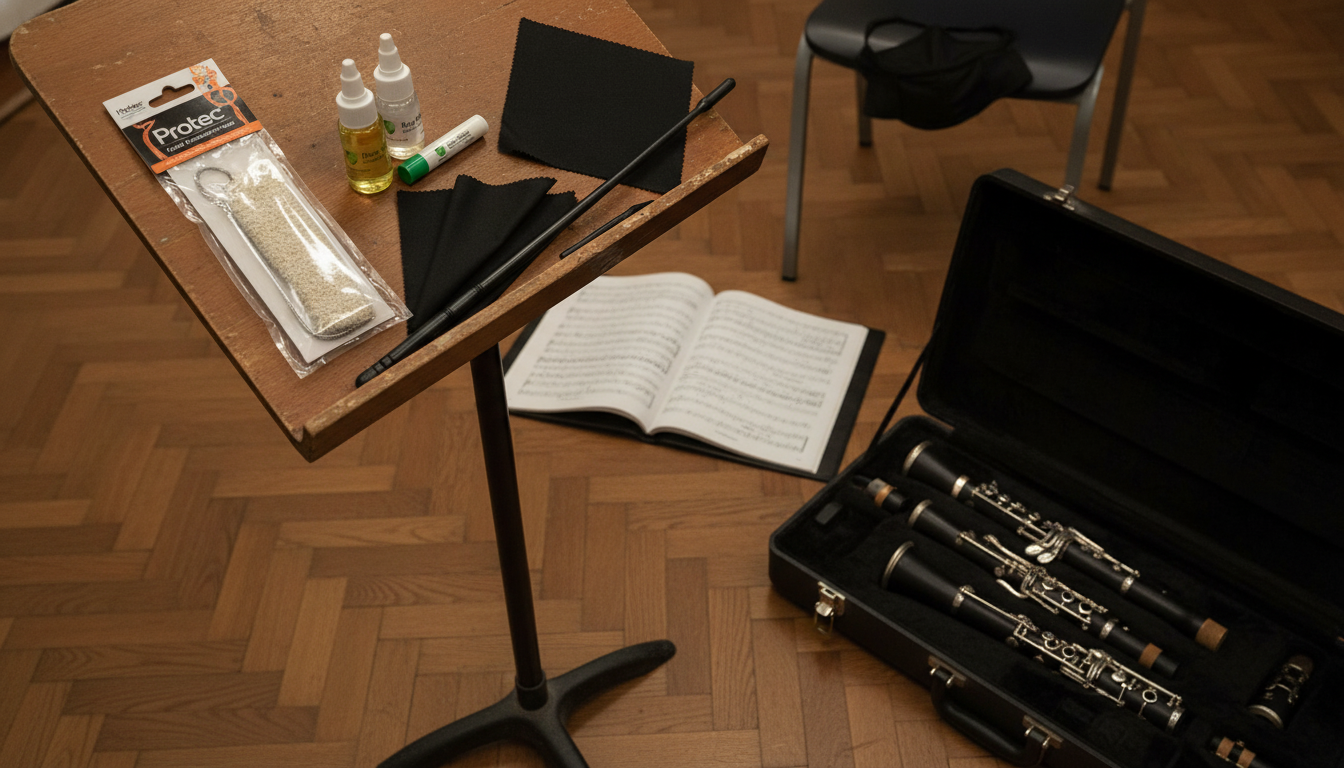
The Clarinet Care Kit from Instrument Clinic covers the full range of what a Bb clarinet needs after a session. Here's what's in it and what each item actually does:
- Two microfiber anti-tarnish polishing cloths — for wiping down the exterior after playing. Microfiber picks up oils and moisture without scratching the finish, and the anti-tarnish treatment helps protect silver-plated keywork over time.
- Cotton cleaning swab — for pulling moisture out of the bore. Thread it through each joint after disassembly and work from the bell upward.
- Bore oil — for wooden clarinets specifically. Bore oil conditions the wood and helps prevent it from drying out and cracking. If you play a plastic clarinet, you can skip this one, but it's essential for wood.
- Key oil — a drop on each key pivot keeps the action smooth and prevents the metal-on-metal wear that leads to wobbly, imprecise keys over time.
- Cork grease — applied lightly to the tenon corks before assembly. Without it, the corks dry out, crack, and eventually need replacing. With it, joints slide together easily and the seal stays airtight.
- Three anti-tarnish storage packets — placed in the case, these absorb moisture and slow tarnishing while the instrument is stored between sessions.
You don't need to use every item after every single session. Cork grease before assembly, swab and polish after — that's the daily routine. Bore oil and key oil are periodic, not daily. But having everything in one kit means you're not hunting for a separate bottle of key oil when you notice a sticky key three days before a performance.
The Baritone Saxophone: The One That Gets Neglected Most
Baritone sax players deal with a problem the other woodwinds don't have: that long, curved loop in the body. Moisture collects in the bend and doesn't drain the way it does in a straight bore. Most players swab the neck and the bell and call it done — the loop stays wet, and over time that buildup affects both the instrument's hygiene and its resonance.
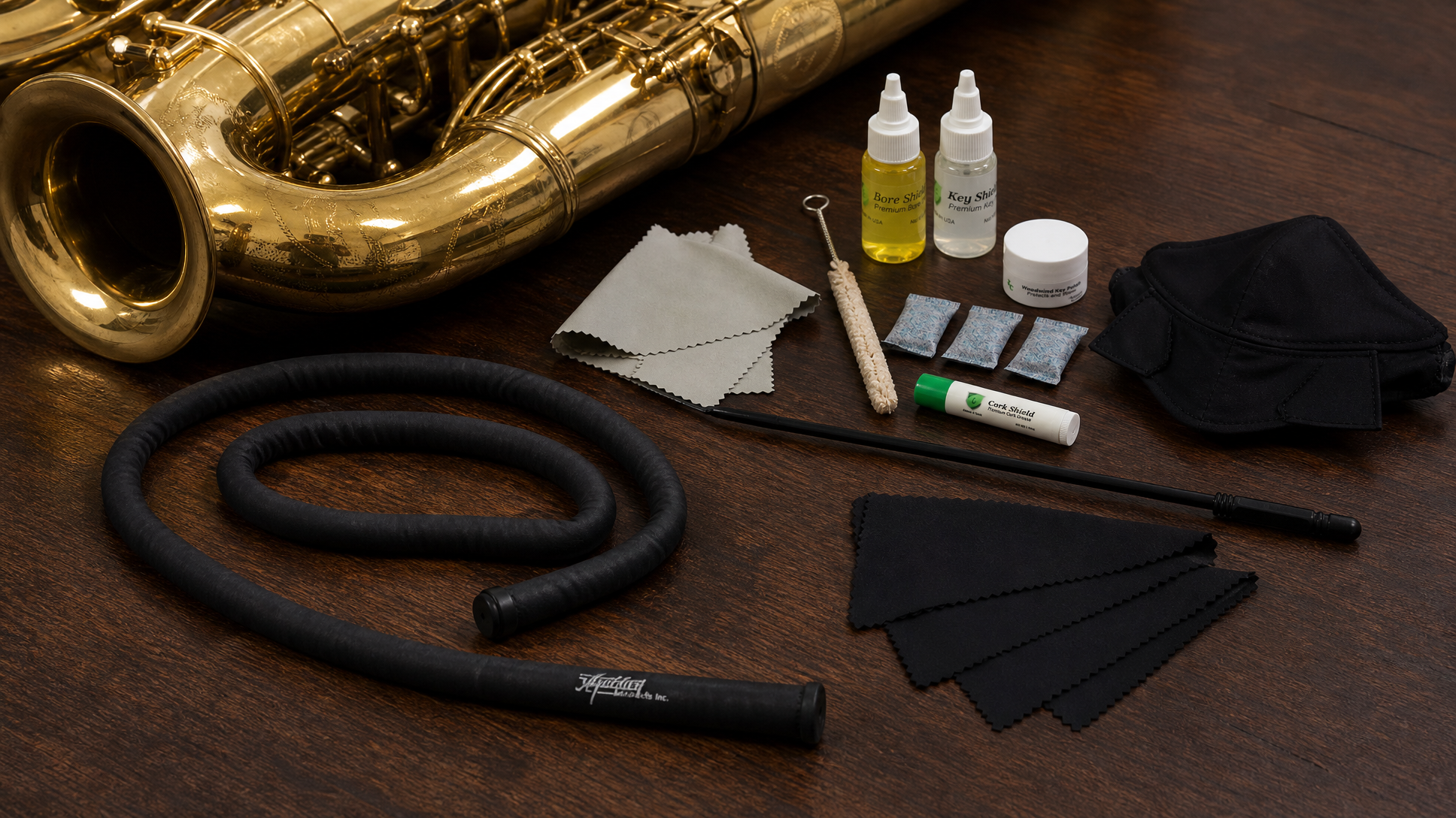
The Hodge Silk Baritone Saxophone Swab is built specifically for this problem. It's a foam-covered flexible snake — 24 inches long — sized to match the diameter of the circular section of the bari sax body, with a silk covering that absorbs the moisture that accumulates in the loop. You push it in from the top of the saxophone, guide it around the bend, and pull it back out. The silk material does the absorbing work; the foam core and flexible construction let it navigate the curve without getting stuck.
This is the kind of tool that seems unnecessary until you've seen what the inside of a neglected bari loop looks like. Silk, specifically, is worth the step up from cotton here — it absorbs quickly and doesn't leave lint behind in the bore.
The Order Matters
Post-session cleaning isn't just about having the right tools — it's about using them in the right sequence. For all three instruments, the general order is: disassemble, swab the bore, wipe the exterior, then apply any lubricants or conditioners. Swabbing before wiping means you're not pushing exterior moisture into the bore when you reassemble. Applying cork grease before the next session (rather than right after) gives it time to absorb into the cork.
For clarinet players specifically: apply key oil sparingly. One small drop per pivot is enough. Too much oil attracts dust and grit, which causes the very stiffness you're trying to prevent.
What Happens When You Skip It
Pad replacement is the most common consequence of skipping post-session cleaning. Pads that stay wet repeatedly lose their ability to seal cleanly, which shows up as air leaks, a flat tone in the lower register, and keys that don't respond the way they should. A full repad on a clarinet or saxophone isn't a small job — it's the kind of thing that sends players searching for instrument repair near me when the problem finally gets bad enough to notice.
The cleaning routine doesn't prevent every repair. But it delays the ones that come from pure neglect, and those are the most avoidable ones.
Browse woodwind cleaning kits and accessories at Emusicmart before your next rehearsal — the right kit for your instrument is a small investment compared to what deferred maintenance eventually costs.
Frequently Asked Questions
How often should I oil the keys on my clarinet?
Key oil doesn't need to go on after every session — once every few weeks of regular playing is a reasonable interval for most players. Apply a tiny drop to each key pivot and work the keys to distribute it. If you notice a key starting to feel stiff or sluggish before that interval, that's your cue to oil sooner rather than later.
Can I use a flute swab on a piccolo?
The DgBRSM cleaning kit is listed as suitable for most flutes and piccolo, so a flute cleaning rod and cloth can work for piccolo as well. The key is making sure the cloth is sized appropriately — piccolo bores are narrower, so fold the cloth to fit snugly rather than forcing a thick bundle through. A cloth that moves too freely won't absorb effectively.
Does bore oil work on plastic clarinets?
Bore oil is formulated to condition wood and prevent it from drying out and cracking — it's specifically for wooden instruments. If your clarinet is plastic (ABS resin), bore oil won't do anything useful and you can skip it. Focus on swabbing the bore and keeping the keys lubricated instead.
Why silk instead of cotton for a saxophone swab?
Silk absorbs moisture quickly and doesn't leave lint or fibers behind in the bore, which is a real concern with cotton swabs in saxophone bodies. For the curved loop section of a baritone saxophone in particular — where the swab has to navigate a tight bend — a silk-covered swab like the Hodge does the job without shedding material that could interfere with the instrument's interior.