Cart
0
The promises vs. the reality
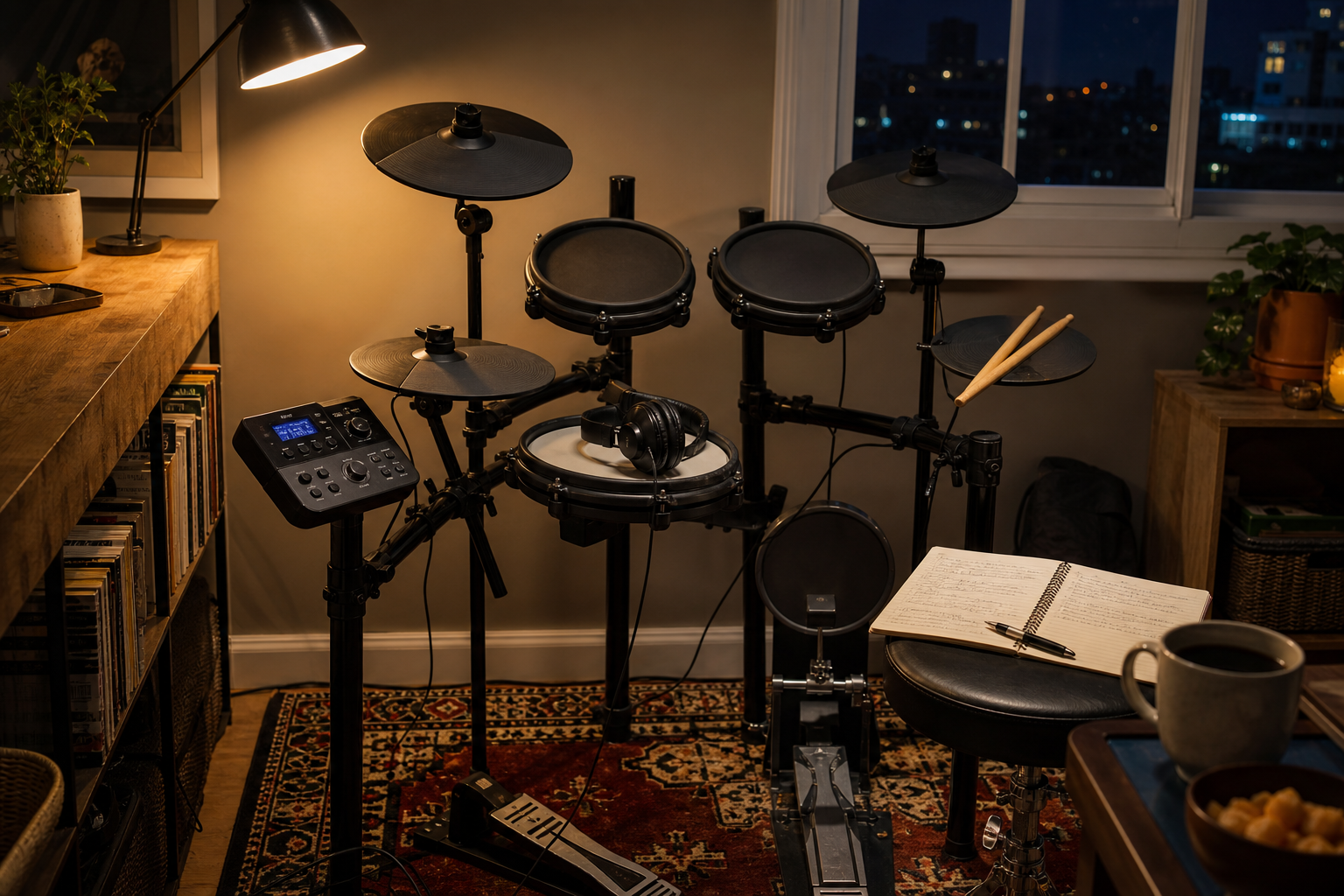
Every product listing for an electronic drum kit says something like "practice in silence" or "realistic feel." Neither of those is exactly a lie, but neither is the full story either. If you buy based on those phrases alone, you're going to be surprised — and not always pleasantly.
Before you spend your money, here are the three things shoppers almost never get a straight answer on: how quiet e-kits actually are, what playing them feels like compared to acoustic drums, and whether they make sense for someone just getting started.
How quiet is "quiet," really?
This is the big one. The short answer: electronic kits are significantly quieter than acoustic drums, but they are not silent.
The noise that remains has two sources. The first is the impact sound — when a stick hits a rubber or mesh pad, there's a sharp tap. It's much softer than a snare crack, but it's real and it travels through walls. The second, and often more disruptive, source is vibration. Every kick pedal strike sends a low-frequency thud through your floor and into the structure of the building. If you're in an apartment with downstairs neighbors, this is the thing that will get you a knock on the door, not the pad noise.
The fix isn't complicated, but it's an extra cost: a proper drum riser or a thick isolation platform under the kit absorbs a lot of that floor vibration. It won't eliminate it entirely, but it makes a meaningful difference. Factor that into your budget before you buy.
For context, playing at a reasonable hour in a house with a ground floor setup is generally fine for most households. Apartment living at any hour is trickier and depends heavily on your building's construction.
Do they feel like real drums?
Honestly? Closer than they used to be, but not identical — and the gap depends a lot on which type of pads you're getting.
Rubber pads are the most common on entry-level kits. They're durable and responsive, but they have a stiff, bouncy rebound that feels different from a drumhead. Your stick comes back faster than it would on an acoustic drum, which can actually reinforce bad technique if you're not paying attention.
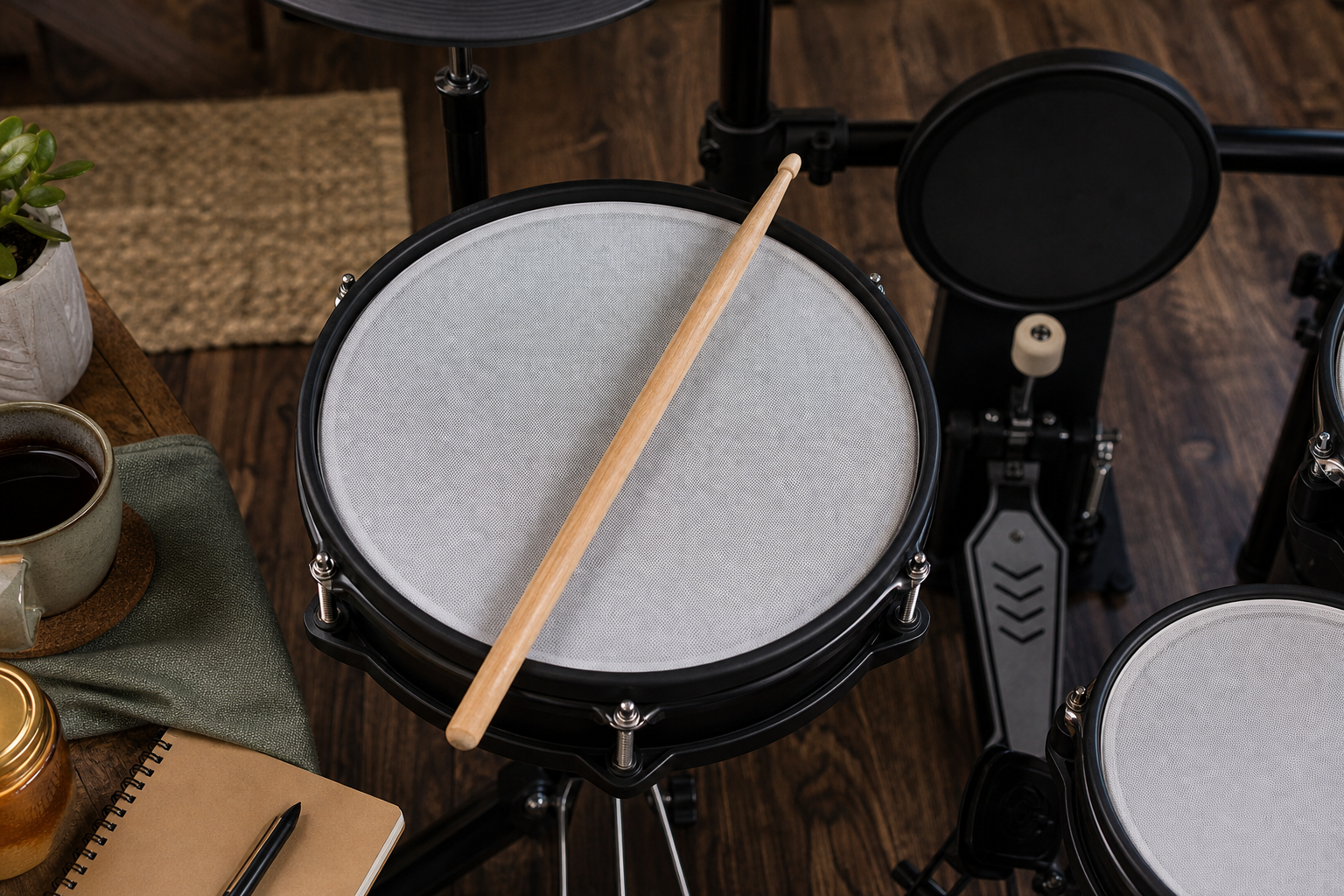
Mesh heads are a step up. They're tensioned fabric heads stretched over a frame, and the feel is noticeably closer to a real drumhead — more give, more natural rebound. Most mid-range and higher kits use mesh on the snare at minimum, and better kits use it across all pads. If feel matters to you, it's worth checking which pads on a kit are mesh before you buy.
The hi-hat is where most e-kits still feel the most artificial. Controlling an acoustic hi-hat with your foot is a nuanced thing, and the single-zone or even dual-zone hi-hat controllers on many kits don't fully replicate it. It's learnable, but it's worth knowing going in.
Cymbals on e-kits are usually solid rubber or thin plastic plates. They don't flex or ring like real cymbals, which takes some adjustment. Higher-end kits use larger, multi-zone cymbal pads that feel more natural, but even those are a different experience.
Is an electronic kit worth it for a beginner?
For most beginners in most living situations: yes, and here's why.
The loudness of acoustic drums is a real barrier to consistent practice. If you can only play when conditions are perfect — the right time of day, no one home, no neighbors close — you're going to practice less. Less practice means slower progress. An e-kit removes that barrier. You can put on headphones and play at 10 p.m. on a Tuesday, and that regularity compounds fast.
The built-in module is also genuinely useful for beginners. Most electronic kits come with a drum module that includes a metronome, pre-loaded rhythms to play along with, and sometimes basic coaching features. None of that replaces a good teacher, but it gives you structured things to work on when you're practicing alone.
The one honest trade-off: if your goal is to eventually play acoustic drums — in a band, at a venue, in a studio — you'll need to spend some time adjusting to the feel and volume of a real kit. Most drummers make that transition without much trouble, but it's not zero adjustment. Think of an e-kit as learning to drive in a car with a slightly different steering weight. The fundamentals transfer; the feel takes a session or two.
What to actually look for when comparing kits
Forget the marketing language and focus on these four things:
- Pad type: Mesh heads on the snare at minimum. All-mesh is better. Rubber-only pads are fine for a first kit on a tight budget but know what you're getting.
- Module quality: The drum brain (module) controls how the kit sounds and responds. Look for one that lets you adjust the sensitivity of each pad individually — this matters a lot for getting a natural feel.
- Hi-hat pedal: A real hi-hat controller pedal (not just a fixed open/closed switch) makes a big difference in playability. Check whether it's included or an add-on.
- Expandability: Can you add a second crash cymbal or an extra tom later? A kit that lets you grow with it is worth more in the long run than one that maxes out at its stock configuration.
One more thing before you order
Electronic kits ship as multi-box orders. Confirm that the retailer you're buying from is clear about what's in the box — specifically whether the throne (drum stool), sticks, and headphones are included or sold separately. Some kits list those items in the product photos but don't include them in the package. If you're buying online, it's worth knowing what to check before you buy any instrument online — especially for a larger purchase like a drum kit.
Ready to find the right kit? Browse electronic drum kits at Emusicmart — shipped across the U.S. with secure checkout and clear return policies so you know exactly what you're getting.
Frequently Asked Questions
Can my downstairs neighbors hear my electronic drum kit?
Quite possibly, yes — especially the kick drum. The pad impact noise is minimal, but the vibration from the kick pedal travels through the floor and into the building structure. A drum isolation riser or thick foam platform under the kit helps significantly. If you're in an apartment, it's the most important accessory to buy alongside the kit itself.
Are mesh pads worth the extra cost over rubber pads?
For most players, yes. Mesh pads have a more natural rebound that's closer to a real drumhead, and they're quieter on impact than rubber. If you're on a tight budget and rubber pads are what's available at your price point, they'll get the job done — but if you can stretch to mesh, especially on the snare, the playing experience is noticeably better.
Can you learn real drumming on an electronic kit?
Yes. The fundamentals — timing, rudiments, coordination between hands and feet — all transfer directly. The main adjustment when moving to an acoustic kit is the volume (which takes a session to get used to) and the slightly different rebound feel. Most drummers who learned on e-kits make the switch without major difficulty.
What accessories do I need that aren't included in most kits?
Check the product listing carefully, but common omissions include a drum throne (stool), drumsticks, and headphones. A drum isolation riser is almost never included but is highly recommended if noise is a concern. Some kits also don't include a hi-hat controller pedal in the base package, so confirm that before you order.