Cart
0
You've booked the gig. The venue confirmed. Now someone asks, "What's your PA situation?" — and your stomach drops a little because you're not entirely sure what that means for you specifically.
This is one of the most common places first-time performers get tripped up. Not the music — they've practiced. It's the gear conversation. What does the venue provide? What do you need to bring? What happens if you show up and the house system is a single Bluetooth speaker from 2017?
Here's a plain-English breakdown of live sound basics for small venues, and the honest answers to the questions most beginners are too embarrassed to ask out loud.
First: What "Small Venue" Actually Means for Sound
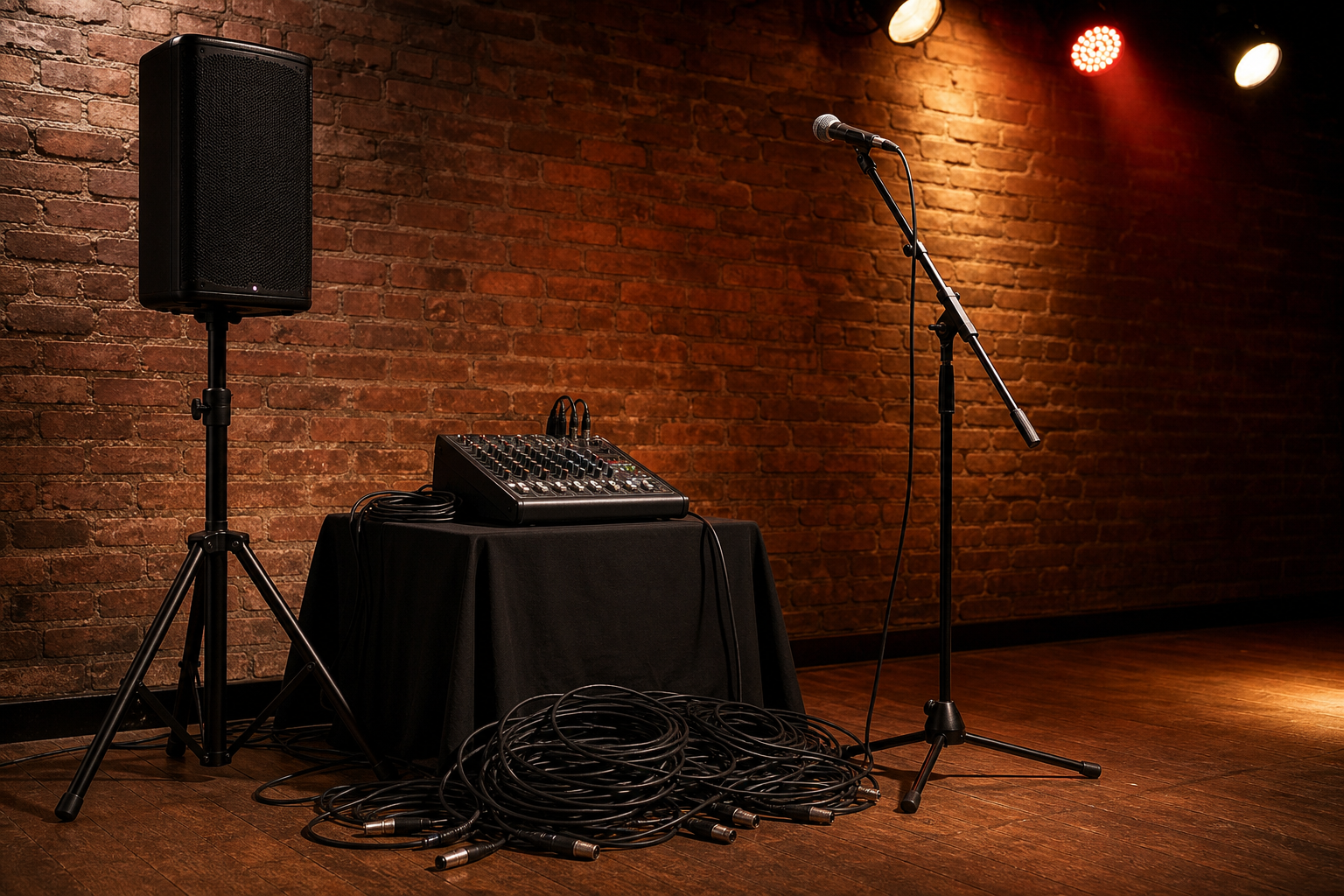
A small venue might be a coffee shop, a bar back room, a restaurant patio, a house show, or a 100-person event hall. The sound demands across those spaces vary more than you'd think — but the gear fundamentals stay the same. You're working with four basic pieces: a PA system (main speakers), a mixer, monitors (or wedges), and cables. Understanding what each does is the starting point for every other decision.
The Four Pieces of a Live Sound Setup
PA Speakers (The Mains)
These are the speakers pointed at the audience. They carry your vocals, your instruments — everything the crowd hears. For small venues, a pair of powered (active) PA speakers is the most practical choice for a solo performer or small band. Powered speakers have the amplifier built in, which means fewer boxes to haul and fewer connections to troubleshoot on a stressful load-in night.
The Mixer
The mixer is where everything gets plugged in — your microphone, a DI box for your acoustic guitar, a keyboard, a laptop for backing tracks. It controls the volume and tone of each input before the signal goes to the speakers. For a solo acoustic act, even a compact 4- or 6-channel mixer is often plenty. Bands typically need more channels, but you don't need to overbuy for your first few gigs.
Monitors (Stage Wedges)
Monitors face back toward you on stage so you can hear yourself. This is the piece most beginners skip — and then regret. When you can't hear your own voice on stage, pitch and timing suffer. Even one small floor monitor makes a significant difference. Some performers run a simple in-ear monitor setup instead, which is lighter to carry and easier to manage solo.
Cables
XLR cables carry balanced audio signals from microphones and DI boxes to the mixer. Speaker cables (or in many cases, XLR again with powered speakers) run from the mixer to the mains. Bring spares. A cable failure mid-set is one of the most avoidable problems in live sound, and a backup XLR costs very little compared to the embarrassment of going silent.
What Venues Usually Provide (and What They Usually Don't)
This is where first-timers get surprised. The honest answer: it depends entirely on the venue, and you should always ask in writing before the show.
Many bars and coffee shops have a "house PA" — a fixed speaker system already installed. Some have a house engineer who runs it. That's the best-case scenario: you just plug in and play. But "house PA" can mean anything from a professional line array to a single powered speaker zip-tied to a wall bracket.
Most small venues do not provide a mixer, monitors, or a microphone stand. Even fewer provide cables. The safest assumption for your first gig: the venue has speakers, and you need to bring everything else. Confirm before you load in.
The Rent vs. Own Question
If you're playing one or two gigs a year, renting a PA system from a local music or event rental shop makes more sense than buying. You avoid storage, maintenance, and the upfront cost of gear you'll use infrequently.
If you're gigging regularly — even monthly — owning your own compact PA setup starts to pay off quickly in both money and convenience. You know your gear, you know how it sounds, and you're not dependent on rental availability the week of a show.
The middle path that works well for a lot of developing performers: own your microphone, your cables, and a small mixer (these are relatively affordable and endlessly reusable), and rent or borrow the main speakers until the gig frequency justifies buying them.
A Few Things That Catch First-Timers Off Guard
- Feedback. That sharp, piercing squeal happens when a microphone picks up its own amplified sound from a speaker. The fix is positioning — keep your mic away from the front of the speakers, and don't point it at a monitor. Gain staging (not cranking the input volume too high) also helps.
- Soundcheck time. Small venues often give you 20 minutes or less. Know your setup before you arrive. Practice plugging everything in at home so the first time you do it under pressure isn't the actual gig.
- Venue acoustics. A brick-walled room sounds very different from a carpeted bar. Hard surfaces reflect sound and can make a room feel muddy. Rolling off some of the high-mids on your mixer can clean things up quickly.
- Power outlets. Ask the venue how many outlets are available at the stage and where they are. Running a powered speaker from an extension cord across a room is a trip hazard and sometimes a blown fuse waiting to happen.
What Gear Do You Actually Need for Your First Gig?
For a solo acoustic performer or a duo: a vocal microphone, a short XLR cable run, a compact mixer, and either the venue's PA or a single powered speaker if the room is small enough. A floor monitor is worth adding as soon as the budget allows.
For a small band: at minimum, a 12- to 16-channel mixer, a pair of powered PA speakers on stands, at least two floor monitors, and enough XLR cables for every input plus a spare or two. A subwoofer is optional for small rooms — in many cases, a pair of full-range powered speakers handles it fine.
The goal isn't to have the most gear. It's to have the right gear, know how to use it, and not be the act that held up the show because something wasn't plugged in correctly.
If you're still working out what you need before your first show, our guide on ordering instruments and gear online covers what to look for and what questions to ask before you buy — useful reading whether it's your first mic or your first PA.
The first gig is always a little chaotic. But the sound side of it doesn't have to be the thing that trips you up. Get the basics right, confirm the venue details ahead of time, and bring one extra cable. That alone puts you ahead of half the acts on any open-mic night.
Browse Emusicmart's Live Sound & Stage selection — practical gear options for gigging musicians at every level, from first-time performers to working bands.
Frequently Asked Questions
Do I need a subwoofer for a small venue gig?
For most small rooms — a bar back room, a coffee shop, a 100-person event space — a pair of full-range powered PA speakers is usually sufficient. A subwoofer adds low-end impact and is worth considering if your set involves a lot of bass-heavy music or a full drum kit in a larger room, but it's not a must-have for your first few small venue shows.
What's the difference between a powered speaker and a passive speaker?
A powered (active) speaker has the amplifier built into the cabinet — you plug it directly into your mixer with an XLR cable and it's ready to go. A passive speaker needs a separate external amplifier to drive it. For most gigging musicians just starting out, powered speakers are the simpler, more portable choice.
How many channels do I need on a mixer for a small band?
Count every input you plan to plug in: vocals, instruments via DI boxes, microphones on amps or drums. Add a couple of channels as a buffer. A four-piece band with a few vocal mics and DI'd instruments can easily fill a 12-channel mixer. It's better to have channels you don't use than to run out mid-setup.
Can I use a Bluetooth speaker as a PA for a small gig?
For casual background music, maybe. For a live performance where you need to project vocals over an audience and potentially over instruments, a consumer Bluetooth speaker won't have the volume, clarity, or connectivity to do the job reliably. A purpose-built powered PA speaker is a meaningfully different tool for live sound.